Third Assistant Engineer · 3AE01 · Engine · Electrical Machines · CURRENT-Q536-Q0006
Synchronous Motors: Increasing Hold-In Torque
Relate stronger rotor-field excitation to increased hold-in torque in a synchronous motor.
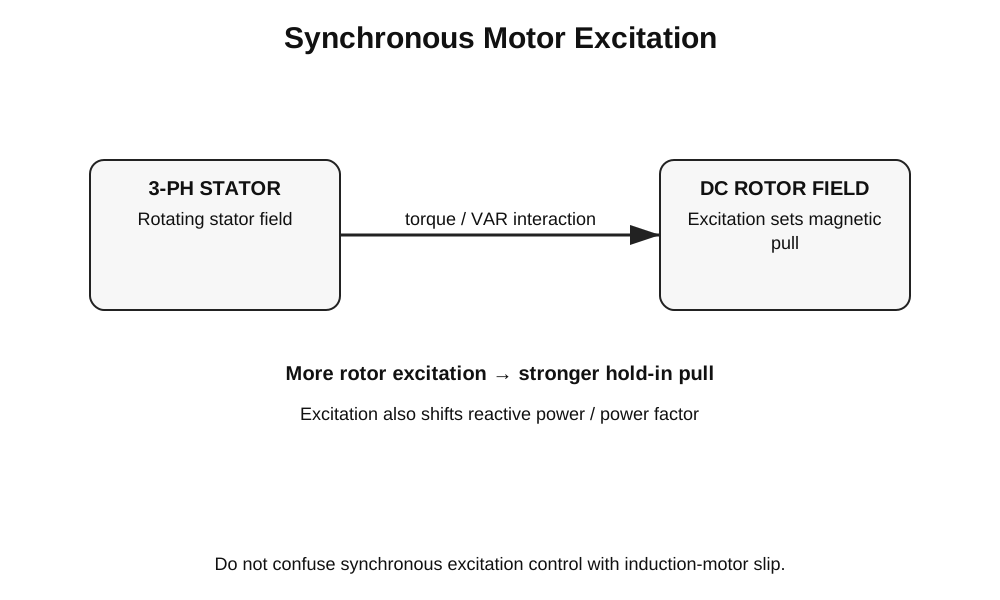
The torque load that a synchronous motor can handle is dependent on the hold-in strength of the poles. Hence, to increase the hold-in torque, it is necessary to __________.
- A. decrease the resistance of the field rheostat
- B. increase the torque angle of the rotor magnets
- C. increase the direct current supplied to the rotor magnets
- D. decrease the 3-phase armature winding current
Correct answer: C. increase the direct current supplied to the rotor magnets
Why this answer is correct
Increase the direct current supplied to the rotor magnets.
Governing principle
A wound-field synchronous motor operates because its DC-excited rotor field locks to the rotating magnetic field produced by the three-phase stator. Load causes the rotor to lag the stator field by the torque angle. The motor remains synchronous only while electromagnetic torque can equal the applied shaft load; the maximum sustainable torque before loss of synchronism is pull-out torque. Increasing rotor DC excitation increases the rotor magnetic field strength and, within the normal unsaturated operating range, increases the available synchronizing/hold-in torque margin.
Reasoning
- The question asks how to increase the motor’s hold-in torque, not merely how to change its instantaneous operating torque.
- The hold-in ability depends on the strength of the interacting rotor and stator magnetic fields.
- Rotor magnetic-field strength is controlled directly by the DC supplied to the rotor field winding or rotor magnets in the terminology used by the question.
- Therefore, increasing the direct current supplied to the rotor magnets is the direct action that increases hold-in torque capability.
- Increasing torque angle raises the load angle toward the pull-out condition; it does not increase the maximum available hold-in strength.
- Reducing three-phase armature-winding current reduces electrical loading but does not directly strengthen the rotor poles.
- Changing field-rheostat resistance can affect excitation current in some field circuits, but the question asks for the necessary direct variable. The best answer is the resulting increase in rotor DC current.
Why the other choices do not fit
A. Not the best answer. In a conventional series field-rheostat circuit, decreasing resistance may increase field current, but that depends on circuit arrangement and operating conditions. It is an indirect control action, whereas the question asks for the direct condition that increases pole hold-in strength.
B. Incorrect. A larger torque angle reflects increased load demand and moves the rotor closer to the approximate pull-out region near 90 electrical degrees. It does not increase the maximum hold-in torque capability.
C. Correct. More DC rotor excitation strengthens the rotor magnetic field and increases the available synchronizing or pull-out torque capability, subject to saturation and equipment limits.
D. Incorrect. Decreasing three-phase armature current may reduce the motor’s present electrical loading, but it does not directly increase rotor-pole strength or the inherent maximum hold-in torque.
Related lesson
Motor Controls and Protection
Flashcard preview
How does synchronous-motor field excitation affect torque?
Increasing DC field excitation strengthens the rotor magnetic field and increases hold-in torque, subject to machine limits.
Sources
- USCG National Maritime Center · Q536 Electrical – Electronic – Control Engineering (Sample Examination) · Question 6, PDF page 2 of 37; lines 51–57 identify the question, all four choices, and “Correct answer: C.”
- U.S. Department of Energy · DOE-HDBK-1011/4-92, DOE Fundamentals Handbook: Electrical Science, Volume 4, Module 12, AC Motors · Module 12, “Synchronous Motors,” printed ES-12 pages 12–14: synchronous motor rotor receives external DC excitation; rotor locks in step with the rotating field; torque angle rises with load; loss of synchronism occurs near α ≈ 90°; maximum torque without loss of synchronism is pull-out torque; field excitation is adjusted by changing DC excitation.
Continue with 60-minute Guest Study, create a free account to save progress, or compare Mariner Notebook Academy Pro access.
Mariner Notebook is an independent study platform and is not affiliated with or endorsed by the United States Coast Guard.