Third Assistant Engineer · 3AE01 · Engine · Hydraulic Systems · CURRENT-Q535-Q0010
Hydraulic Accumulators: Stored Energy
Recognize pressurized fluid storage as the mechanism that preserves hydraulic energy for later use.
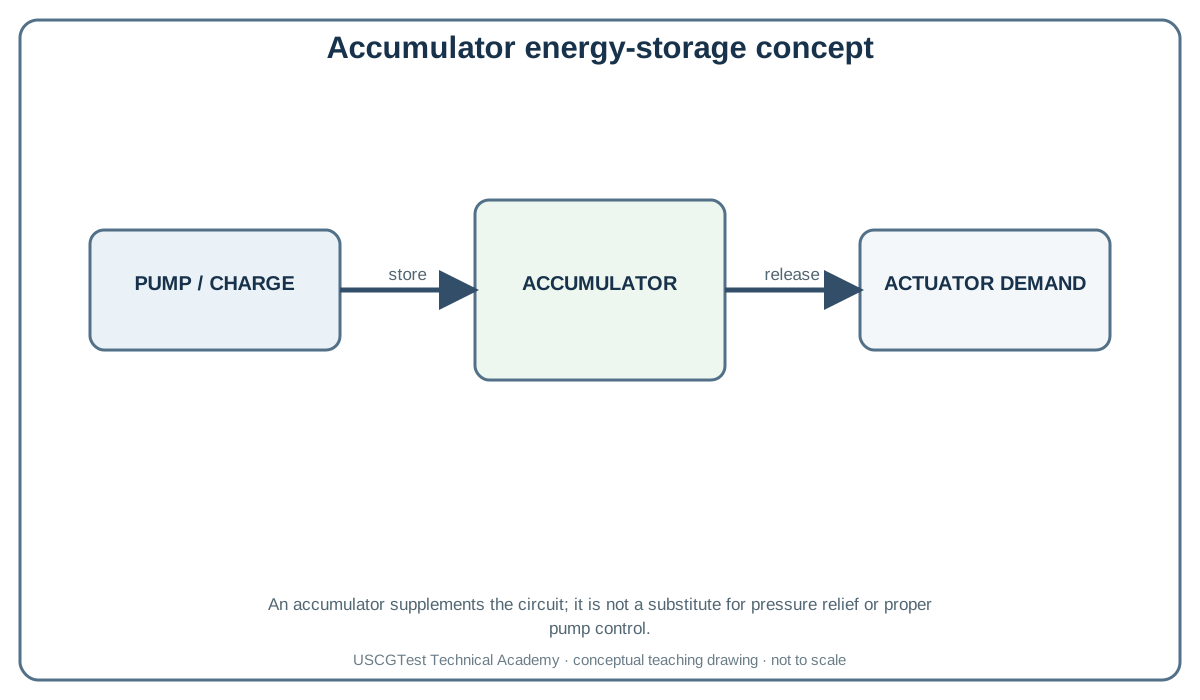
Which of the listed components of a hydraulic system would enable the pump to be temporarily shut down, and yet still provide an instantaneous source of hydraulic force?
- A. Sump actuator
- B. Pressure compensator valve
- C. Modulator
- D. Accumulator
Correct answer: D. Accumulator
Why this answer is correct
D — Accumulator. It is the hydraulic system component specifically intended to store pressurized fluid energy for later, rapid use.
Governing principle
Hydraulic force is produced when pressure acts on an actuator area. An accumulator is a pressure-storage device: the pump charges it by forcing hydraulic oil against a compressible gas, spring, or weight. When demand occurs or pump output is temporarily unavailable, the stored energy drives oil back into the circuit, restoring flow and pressure to operate an actuator. In a typical gas-charged accumulator, compressed gas expands and forces the stored oil into the system.
Reasoning
- Identify the required function: the component must retain hydraulic energy while the pump is off, then release it immediately.
- An accumulator performs that function because it stores pressurized oil and discharges it back into the system.
- A pressure compensator valve regulates pressure or pump output; it does not itself store a usable volume of pressurized oil.
- A modulator alters or controls hydraulic pressure/flow characteristics; it is not an energy-storage device.
- An actuator converts hydraulic pressure and flow into mechanical motion; it consumes hydraulic energy rather than serving as the reserve source.
- Therefore, the listed component that provides the temporary instantaneous source of hydraulic force is the accumulator.
Why the other choices do not fit
A. Incorrect. A sump is associated with collecting or holding return fluid, while an actuator converts hydraulic energy into mechanical motion. Neither description identifies a component that stores pressurized hydraulic energy for later discharge.
B. Incorrect. A pressure compensator valve regulates or limits pressure and/or pump displacement in a hydraulic system. It has no energy-storage function and cannot by itself provide hydraulic force after pump shutdown.
C. Incorrect. A modulator changes or controls hydraulic pressure, flow, or response characteristics. It is a control component, not a pressurized-fluid energy reservoir.
D. Correct. An accumulator stores hydraulic fluid under pressure and can release that stored fluid promptly to supply hydraulic pressure, flow, and resulting actuator force for a limited period when the pump is shut down.
Related lesson
Hydraulic and Air Starting Systems
Flashcard preview
What energy does a hydraulic accumulator store?
A hydraulic accumulator stores potential energy by retaining hydraulic fluid under pressure, allowing short-duration flow or force when the pump is unloaded or stopped.
Sources
- USCG National Maritime Center · Q535 Q535-General Subjects · Question 10 and official answer key; supplied source SHA-256: e82b5ee704e7c547d4f785b6f162c37429f34b9c64ef27aa515809f9d58f32f3
- United States Navy, Naval Education and Training Command · NAVEDTRA 14264A, Chapter 9, Hydraulic and Pneumatic Systems · Section 1.3.7, “Accumulators,” PDF pages 15–17; specifically PDF page 15, lines 520–535, and PDF pages 16–17, lines 536–561 in retrieved text
- United States Environmental Protection Agency, Office of Transportation and Air Quality · How Accumulators Work · Page lines 18–19 and 24–35; sections “Bladder Accumulator Type” and “Piston Accumulator Type”
- Occupational Safety and Health Administration · LOTO of hydraulic systems; postal workers' exposure to hazardous material spills · Questions 1–3 and replies; page lines 47–59; discusses 29 CFR 1910.147(d)(5)(i)
Continue with 60-minute Guest Study, create a free account to save progress, or compare Mariner Notebook Academy Pro access.
Mariner Notebook is an independent study platform and is not affiliated with or endorsed by the United States Coast Guard.