Third Assistant Engineer · 3AE01 · Engine · Diesel Engine Valve Gear · CURRENT-Q531-Q0016
Diesel Camshafts: Operating Conditions Controlled
Connect cam position and profile to firing order, valve timing and valve lift in a diesel engine.
The arrangement and shape of the cams on a diesel engine camshaft directly control which of the listed groups of operating conditions?
- A. Speed, torque, and horsepower production
- B. Firing order, valve timing, and valve lift
- C. Fuel consumption, efficiency, and cylinder pressure
- D. Scavenge pressure, compression ratio, and exhaust pressure
Correct answer: B. Firing order, valve timing, and valve lift
Why this answer is correct
B — Firing order, valve timing, and valve lift.
Governing principle
A camshaft converts rotary motion into precisely sequenced valve and, on applicable mechanically actuated diesel engines, fuel-injection motion. Cam angular placement around the shaft determines when each cylinder’s events occur relative to the crankshaft and other cylinders. The lobe profile determines follower travel versus cam angle: its base circle, flanks, nose, and duration establish valve opening and closing timing, opening/closing rate, and maximum lift.
Reasoning
- Identify the direct mechanical outputs of a camshaft: timed motion and displacement of followers, valves, and, where fitted, mechanically actuated fuel-injection components.
- Match cam-lobe angular arrangement to sequence among cylinders; this supports firing-order coordination.
- Match lobe position and profile to valve opening/closing points and follower travel; these are valve timing and valve lift.
- Therefore the only group made up of direct camshaft-controlled conditions is B.
- Reject outcome variables in A and C because they are performance results influenced by many systems and settings, rather than the direct motion variables named in the question.
- Reject D because scavenge and exhaust pressures depend on gas-path and operating conditions, while compression ratio is primarily geometric.
Why the other choices do not fit
A. Incorrect. Engine speed is governed by load and speed-control/fuel-control systems; torque and horsepower are performance outputs. Cam design can influence them indirectly, but the listed items are not direct camshaft motion variables.
B. Correct. Lobe arrangement/indexing coordinates cylinder sequence or firing-order-related events, and lobe location/profile directly establishes valve-event timing and valve lift.
C. Incorrect. Fuel consumption, efficiency, and cylinder pressure can change as consequences of valve and injection timing, air supply, fuel quantity, load, and combustion conditions. They are not directly defined by cam arrangement and shape.
D. Incorrect. Scavenge and exhaust pressures arise from gas-exchange equipment and operating conditions. Compression ratio is primarily determined by cylinder and piston geometry, not the cam-lobe arrangement or profile.
Related lesson
Bearings, Valve Gear, Rings and Valve-Lash Basics
Flashcard preview
What should you remember about cam-profile timing and lift?
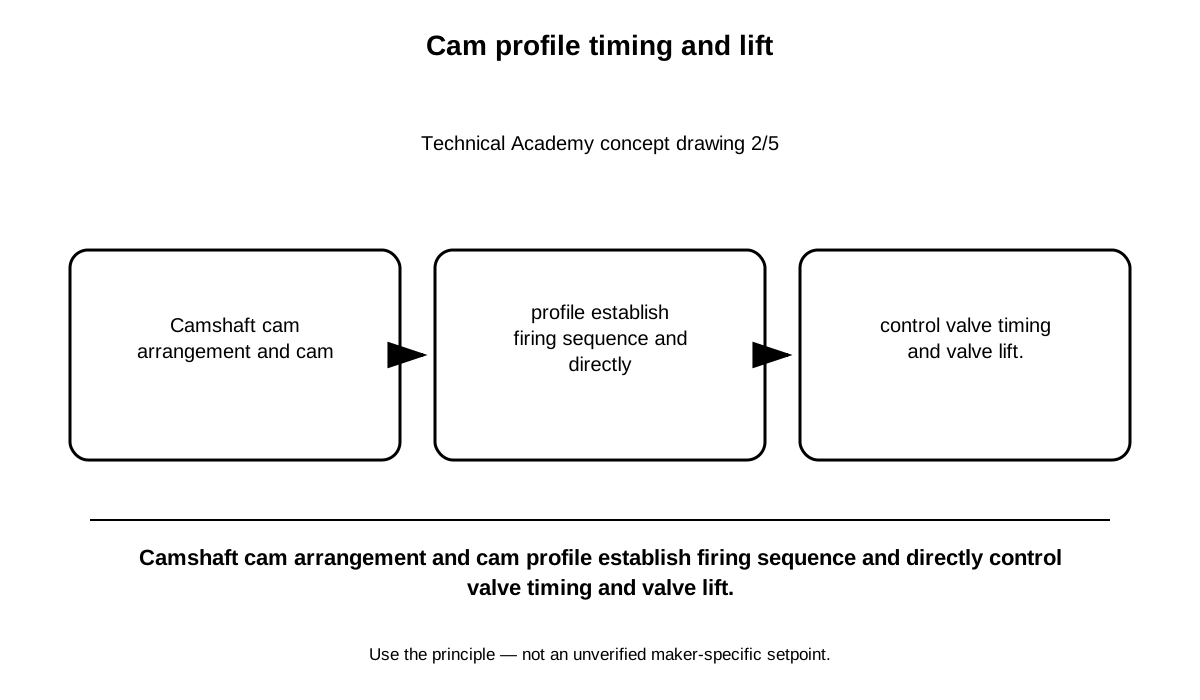
Camshaft cam arrangement and cam profile establish firing sequence and directly control valve timing and valve lift.
Sources
- USCG National Maritime Center · Q531 Motor Plants I · Question 16, PDF page 3 in extracted document pagination; lines 125-131. The question lists choice B as “Firing order, valve timing, and valve lift” and identifies B as the correct answer.
- U.S. Environmental Protection Agency · Test and Quality Assurance Plan: Universal Cams, LLC, Dynamic Cam Diesel Engine Retrofit System · Section 2.1, “Technology Description,” PDF/text lines 356-363; the document explains that camshaft lobes control when valves open and close, opening/closing rates, and how high (lift) they open, and states that lobe shape relates directly to engine performance at different speed ranges.
- NASA Glenn Research Center · Timing System · “The timing system” and “How Does It Work?” sections. The page explains that cam surfaces actuate valves at specified times and intervals during shaft rotation, that different cams move at different times to support firing order, and that varying cam radius moves the follower.
Continue with 60-minute Guest Study, create a free account to save progress, or compare Mariner Notebook Academy Pro access.
Mariner Notebook is an independent study platform and is not affiliated with or endorsed by the United States Coast Guard.