Third Mate · ONC02 · Deck · Rules of the Road · CURRENT-Q100-Q0011
Stand-On Vessel: Three Decision Phases
Apply Rule 17 from the initial keep-course-and-speed duty through permitted and mandatory avoiding action.
BOTH INTERNATIONAL & INLAND Which is TRUE of a power-driven stand-on vessel?
- A. required to give-way in a crossing situation
- B. required to maintain course and speed in a crossing situation but may take action to avoid collision
- C. required to sound the first passing signal in a meeting situation
- D. free to maneuver in any crossing or meeting situation as it has the right of way
Correct answer: B. required to maintain course and speed in a crossing situation but may take action to avoid collision
Why this answer is correct
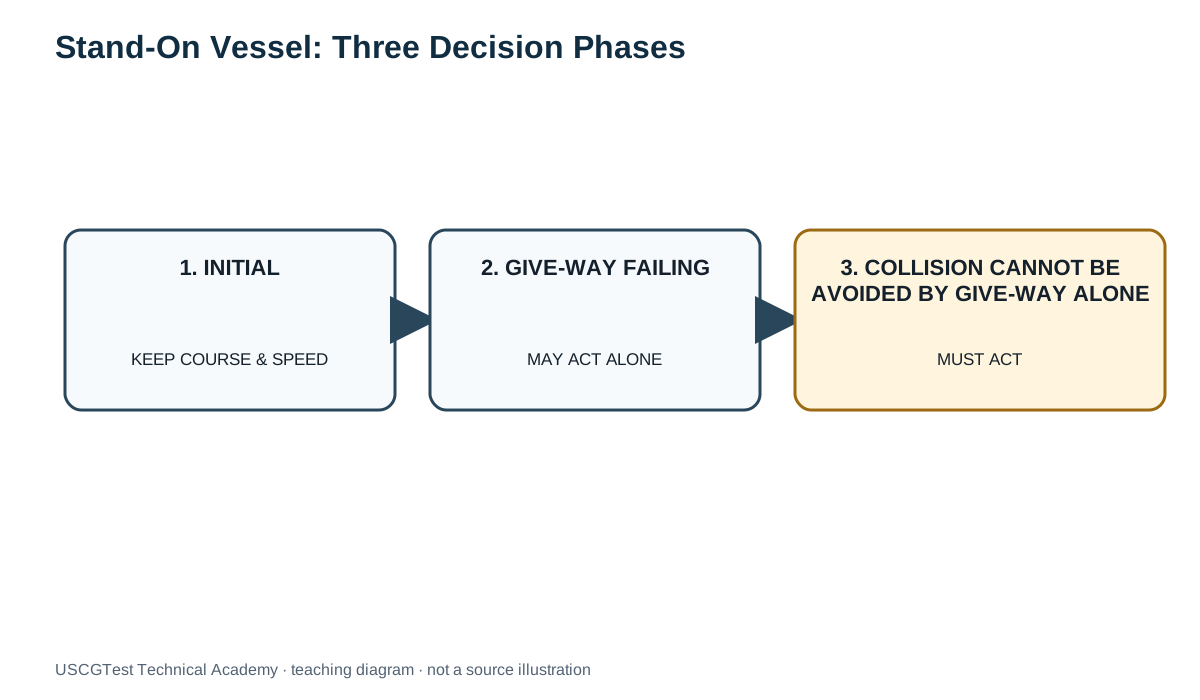
The stand-on vessel maintains course and speed, may act when the give-way vessel is not acting, and must act when collision cannot be avoided by the give-way vessel alone.
Governing principle
Rule 17 creates a sequence of normal duty, permitted intervention and mandatory intervention.
Reasoning
- Initially maintain course and speed so intentions remain predictable.
- When give-way action is plainly inadequate, the stand-on vessel may maneuver.
- When collision cannot be avoided by give-way action alone, the stand-on vessel must take the best available action.
Why the other choices do not fit
A. A stand-on vessel is not the vessel initially required to give way in the crossing situation.
C. The first passing signal is not a universal defining duty of a stand-on vessel.
D. Stand-on status never permits arbitrary maneuvering or removes the duty to avoid collision.
Related lesson
Meeting, Crossing & Stand-On/Give-Way — Head-On, Crossing, Sailing and Responsibility Hierarchy
Flashcard preview
What is the stand-on vessel’s initial duty?
The stand-on vessel initially keeps course and speed. That stable behavior helps the give-way vessel predict the encounter and maneuver safely.
Sources
- USCG Navigation Center · Amalgamated Navigation Rules · Rule 17 — Action by Stand-on Vessel
- USCG National Maritime Center · Q100 Rules of the Road: International and Inland · Question 11 and official answer key
Continue with 60-minute Guest Study, create a free account to save progress, or compare Mariner Notebook Academy Pro access.
Mariner Notebook is an independent study platform and is not affiliated with or endorsed by the United States Coast Guard.