Chief Mate · ONC01 · Deck · Celestial Navigation · CURRENT-Q106-Q0001
Low-Altitude Sun Sights: Refraction Risk
Identify unusual atmospheric refraction as the primary risk when taking Sun sights close to the horizon.
Why are low altitude sun sights not generally used?
- A. The glare on the horizon causes irradiation errors.
- B. Errors due to unusual refraction may exist.
- C. Modern sight reduction tables are not complete for low altitudes below 5°.
- D. Sextants may have large errors at small angles of elevation.
Correct answer: B. Errors due to unusual refraction may exist.
Why this answer is correct
Choose B: errors due to unusual refraction may exist.
Governing principle
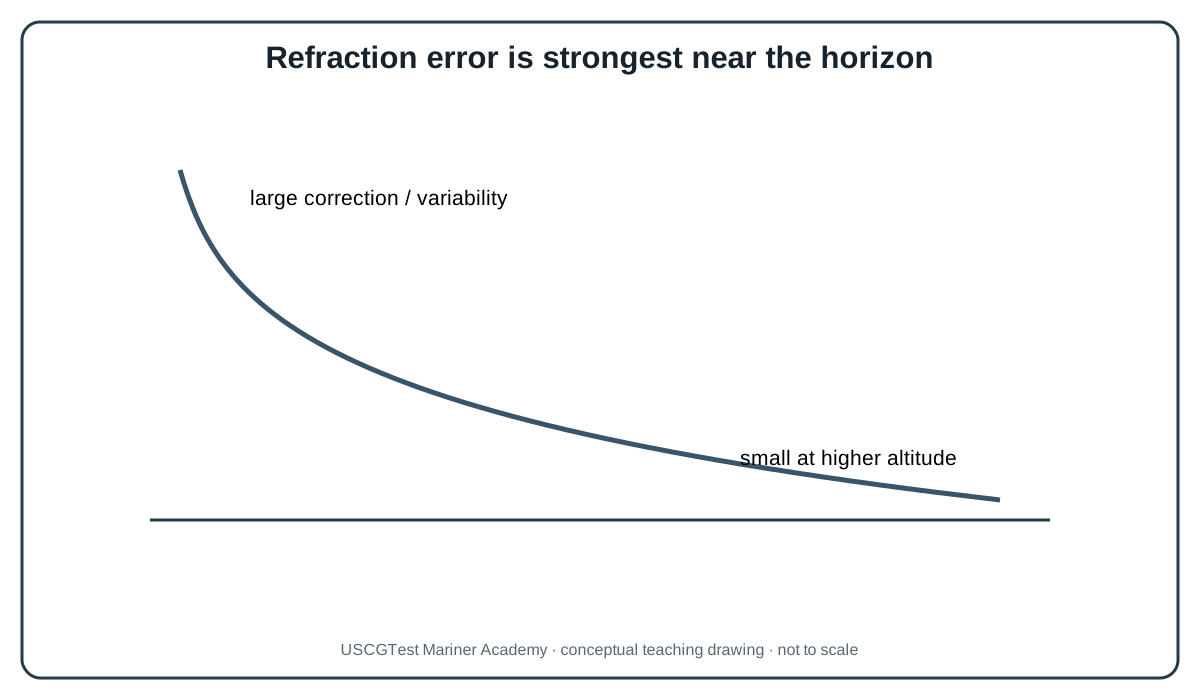
A sextant measures the apparent altitude of the Sun, not its unrefracted geometric altitude. Light from a low-altitude body passes through a long, near-horizontal path in the lower atmosphere, where temperature and density gradients can depart substantially from the standard atmospheric conditions assumed by ordinary refraction corrections. Near the horizon, refraction therefore can be anomalous and can cause a materially erroneous celestial line of position.
Reasoning
- 1. A Sun sight depends on accurately converting apparent altitude into true altitude.
- 2. The atmospheric-refraction correction is normally based on assumed or average atmospheric behavior.
- 3. At low altitudes, the observed ray travels through a much longer portion of the lower atmosphere than it does at higher altitudes.
- 4. Strong or irregular near-surface temperature and density gradients can bend the ray by an amount that differs from the normal correction.
- 5. The resulting altitude error transfers directly into the celestial reduction and may produce an unreliable line of position.
- 6. Therefore, the governing reason low-altitude Sun sights are not generally used is the possibility of errors from unusual refraction: choice B.
Why the other choices do not fit
A. Incorrect as the best answer. Horizon glare can make the horizon or limb harder to define and can degrade an individual observation, but it is not the general technical reason low-altitude Sun sights are avoided. The sealed official key identifies unusual refraction as the governing concern.
B. Correct. Near the horizon, local atmospheric variation can make refraction differ unpredictably from standard corrections. That can produce a significant altitude error and an unreliable celestial result.
C. Incorrect. The issue is not that modern sight-reduction tables are incomplete below 5 degrees. The governing problem is the reliability of the atmospheric correction under unusual near-horizon conditions, not a lack of tabular coverage.
D. Incorrect. Sextant error can affect any observation and must be checked through proper adjustment and index correction. Small elevation angle is not the stated general reason for avoiding low-altitude Sun sights; anomalous refraction is.
Related lesson
Sextant Principles & Altitude Corrections
Flashcard preview
Why are low-altitude celestial sights vulnerable to unusual error?
Atmospheric refraction is greatest near the horizon and decreases rapidly as altitude increases; low-altitude sights are therefore more vulnerable to abnormal-refraction error.
Sources
- USCG National Maritime Center · Q106 Q106-Navigation General: Oceans · Question 1 and official answer key, as supplied in the question record; official answer: "Errors due to unusual refraction may exist."
- National Oceanic and Atmospheric Administration, National Ocean Service · United States Coast Pilot 1, Chapter 3 · Paragraphs 246-249, PDF page 151; web-text lines 15229-15270.
- National Aeronautics and Space Administration, Jet Propulsion Laboratory · Horizons System Manual · Section "Normal Table RETS-Marker Mode," lines 2362-2381; especially lines 2376-2380.
- National Aeronautics and Space Administration · Chapter 6: Electromagnetics · Section "Refraction in Earth's Atmosphere," discussion stating that atmospheric refraction is greatest near the horizon and decreases as the object gains altitude.
Continue with 60-minute Guest Study, create a free account to save progress, or compare Mariner Notebook Academy Pro access.
Mariner Notebook is an independent study platform and is not affiliated with or endorsed by the United States Coast Guard.