Chief Mate · ONC01 · Deck · Voyage Calculations · CURRENT-Q108-Q0004
Fuel, Speed and Endurance: Square-Law Range
Combine fuel per mile with the speed-squared relationship to estimate remaining vessel range.
You have steamed 632 miles at 18.5 knots and consumed 197 tons of fuel. If you have 278 tons of usable fuel remaining, how far can you steam at 15.0 knots?
- A. 1100 miles
- B. 892 miles
- C. 1357 miles
- D. 681 miles
Correct answer: C. 1357 miles
Why this answer is correct
Select C, 1357 miles. Slowing from 18.5 knots to 15.0 knots reduces the assumed propulsion fuel burned per mile, so the remaining 278 tons carries the vessel farther than a direct tons-per-mile calculation would indicate.
Governing principle
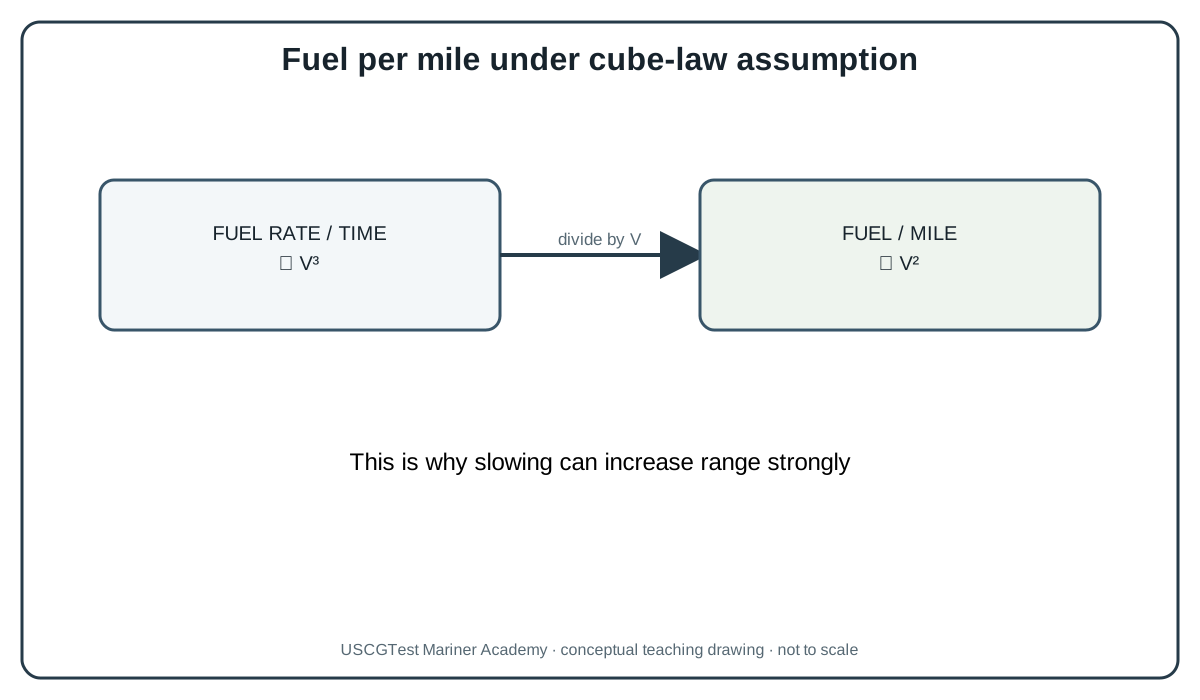
For this examination problem, propulsion fuel consumption rate is assumed proportional to the cube of vessel speed. Because voyage time per mile is inversely proportional to speed, fuel consumed per mile is proportional to the square of speed. Therefore, for otherwise comparable conditions, range varies inversely with the square of speed for a fixed fuel quantity.
Reasoning
- Known passage time: 632 nautical miles ÷ 18.5 knots = about 34.16 hours.
- Known fuel rate at 18.5 knots: 197 tons ÷ 34.16 hours = about 5.77 tons per hour.
- At 15.0 knots, apply the cubic-speed assumption: new hourly rate = 5.77 × (15.0/18.5)^3 tons per hour.
- Equivalently and more directly, calculate the new range: 632 × (278/197) × (18.5/15.0)^2 = about 1356.6 nautical miles.
- Round to the offered answer: 1357 miles, choice C.
- Choice check: A (1100 miles) understates the square-law range gain; B (892 miles) merely scales fuel by the original tons-per-mile rate and ignores the speed reduction; C matches the calculation; D (681 miles) is inconsistent with having more usable fuel remaining than was consumed on the original 632-mile passage and with slowing down.
Why the other choices do not fit
A. 1100 miles is too low. It recognizes some range increase from the extra fuel but does not correctly apply the full square-of-speed adjustment required by the exam model.
B. 892 miles is the constant-consumption-per-mile result: 632 × 278/197 ≈ 892 miles. It ignores that reducing speed from 18.5 to 15.0 knots reduces modeled fuel burn per mile.
C. 1357 miles is correct: 632 × (278/197) × (18.5/15.0)^2 ≈ 1356.6 miles, rounded to 1357 miles.
D. 681 miles is not supportable under the stated simplified conditions. It is less than the direct proportion result despite 278 tons remaining versus only 197 tons consumed on the original run, and it disregards the fuel-saving effect of the lower speed.
Related lesson
Fuel, Speed & Endurance Calculations
Flashcard preview
How is range estimated with a fixed remaining fuel quantity after a speed change?
First scale the known fuel per mile by the square of the speed ratio, then divide the remaining fuel by the new fuel-per-mile value.
Sources
- USCG National Maritime Center · Q108 Navigation Problems–Near Coastal · Page 2 of 6, Question 4 and displayed correct answer; document dated 8/5/2025
- Electronic Code of Federal Regulations, reproduced by Cornell Legal Information Institute · 46 CFR § 11.901, General provisions · 46 CFR 11.901(a)
- U.S. Department of Transportation, Maritime Administration, Ship Operations Cooperative Program · Marine Vessel Energy Efficiency Report, Job 15099.01, Rev. - · Page 76, section discussing fuel-consumption monitoring and the vessel speed–power relationship
Continue with 60-minute Guest Study, create a free account to save progress, or compare Mariner Notebook Academy Pro access.
Mariner Notebook is an independent study platform and is not affiliated with or endorsed by the United States Coast Guard.