Chief Mate · ONC01 · Deck · Damage Stability · CURRENT-Q103-Q0003
Damage Stability: Correct the Slack Tank First
Recognize very low effective GM, remove free-surface loss and improve trim after damage forward.
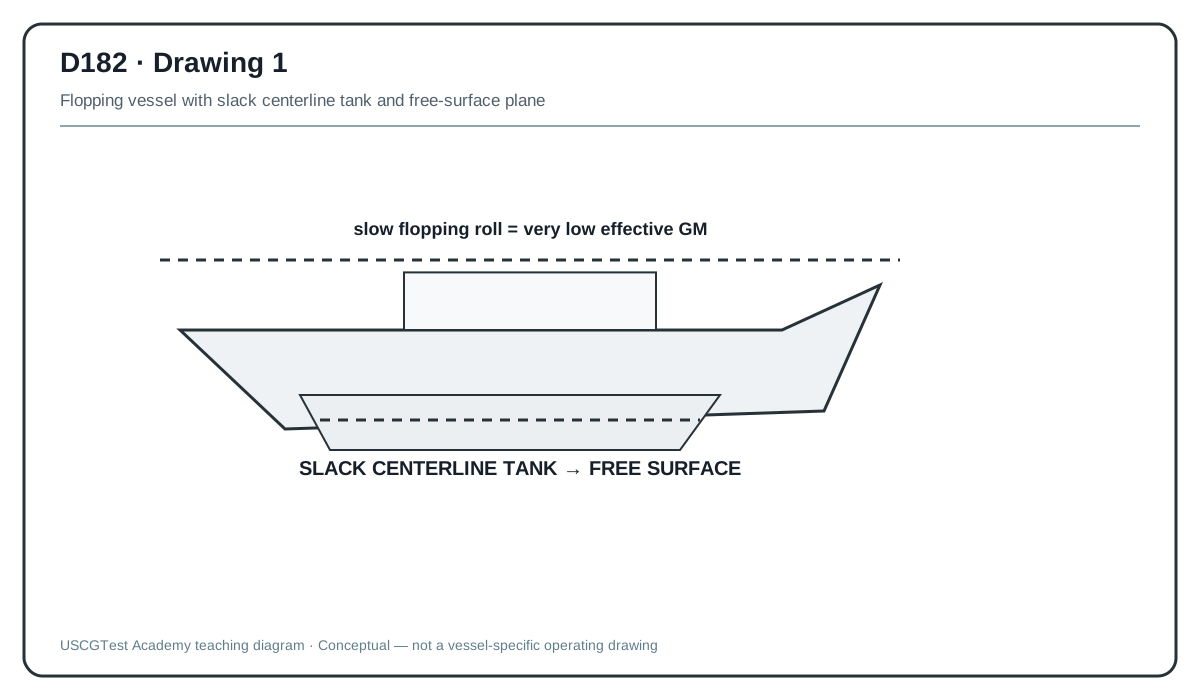
Your vessel is damaged and listing to port. The rolling period is long, and the vessel will occasionally assume a starboard list. Which action should you take FIRST?
- A. Fill an empty double bottom tank on the starboard side
- B. Transfer all possible movable weights from port to starboard
- C. Pump out ballast from the port and starboard double bottom tanks
- D. Press up a slack centerline double bottom tank
Correct answer: D. Press up a slack centerline double bottom tank
Why this answer is correct
Select D: press up the slack centerline double bottom tank.
Governing principle
A partially filled liquid tank permits liquid to move transversely as the vessel rolls. This free-surface effect produces a virtual rise in the vessel’s center of gravity, reduces effective GM and righting ability, and can contribute to a long, sluggish roll and lolling from one side to the other. A centerline double-bottom tank is especially important because its free surface acts regardless of whether the vessel is heeled to port or starboard. Pressing it completely full eliminates that tank’s free surface while placing ballast low in the vessel.
Reasoning
- The vessel is damaged, has a long rolling period, and occasionally takes a starboard list despite initially listing to port. Those facts indicate that the principal immediate concern is inadequate transverse stability, including the effect of slack liquids.
- A slack centerline double-bottom tank has a free surface that shifts as the vessel rolls either way. This reduces effective GM and righting capability; the loss is not cured merely by choosing a side to ballast.
- Pressing up the centerline tank eliminates its free surface and adds weight at a low location. That directly addresses the stated stability symptoms before a transverse weight transfer or one-sided ballasting is attempted.
- After this immediate action, the master should use the vessel-specific damage-control, flooding-effect, and approved stability information to determine safe follow-on ballasting, deballasting, cargo movement, pumping, and watertight-integrity actions.
Why the other choices do not fit
A. Incorrect as the first action. Filling an empty starboard double-bottom tank may eventually counter a genuine port list, but it creates a one-sided weight change and introduces a temporary free-surface condition while filling. It does not first remove the known slack centerline free surface that is reducing stability in both directions.
B. Incorrect as the first action. Moving weight from port to starboard may reduce a port list, but the vessel also occasionally lists to starboard, indicating the issue is not simply a fixed port-side heeling moment. Moving weights can create additional operational risk and does not eliminate the slack-tank free surface causing loss of effective stability.
C. Incorrect as the first action. Pumping out port and starboard double-bottom ballast may reduce free surface only after tanks are completely emptied and stripped, but during the operation it can create or retain slack-tank free surfaces and removes low ballast. It may also adversely affect draft, trim, reserve buoyancy, and damage stability. The known slack centerline tank should be addressed first.
D. Correct. Pressing up the slack centerline double-bottom tank removes the immediate free-surface effect that reduces GM and righting ability regardless of which side the vessel is heeled. It also places ballast low, subject to the vessel’s approved stability and damage-control limitations.
Related lesson
Damage Stability & Grounding
Flashcard preview
When damage produces stern trim plus free-surface instability, what should be corrected first?
First remove harmful slack-tank free surface in a way that also improves trim; only then add additional ballast if needed and safe.
Sources
- USCG National Maritime Center · Q103 Deck Safety · Question 3, PDF page 1, lines 27-33 in retrieved text; dated August 5, 2025 in the document header.
- U.S. Coast Guard · Navigation and Vessel Inspection Circular No. 5-86, Safety of Commercial Fishing Industry Vessels · Enclosure (1), section E, “Free Surface Effects,” PDF page 23, especially paragraphs E.1.a through E.1.d; and section G, “Ballast,” PDF page 25, paragraphs G.1-G.2.
- U.S. Coast Guard, Commercial Vessel Compliance · A Best Practices Guide to Vessel Stability · “Free Surface – Slack Tanks,” PDF page 31; retrieved text describes slack-tank liquid shifting, reduction of righting-arm capability, and recommendations to minimize slack tanks and keep certain liquid spaces completely empty or pressed full.
- International Maritime Organization, hosted by U.S. Coast Guard Marine Safety Center · MSC 85/26/Add.1, Report of the Maritime Safety Committee on its eighty-fifth session, Annex 2 stability-test procedures · Annex 2, section 2.1.2, “Free surface and slack tanks,” and section 2.1.3, “Pressed-up tanks,” PDF page 77 in retrieved text.
Continue with 60-minute Guest Study, create a free account to save progress, or compare Mariner Notebook Academy Pro access.
Mariner Notebook is an independent study platform and is not affiliated with or endorsed by the United States Coast Guard.